


Summary of this article:When it comes to importing from China, are you focusing solely on “buying at low prices”? However, there is a critical point you must address before doing so. That point is “country-of-origin labeling.” If you overlook this, your goods are likely to be held up at customs, resulting in costs and delays far greater than you might imagine. In this article, we’ll explain the actual problems that arise from mislabeled country of origin, along with specific measures to prevent these risks. We’ll also provide a detailed introduction to the solutions offered by hubbuyer.
What is misrepresentation of origin?
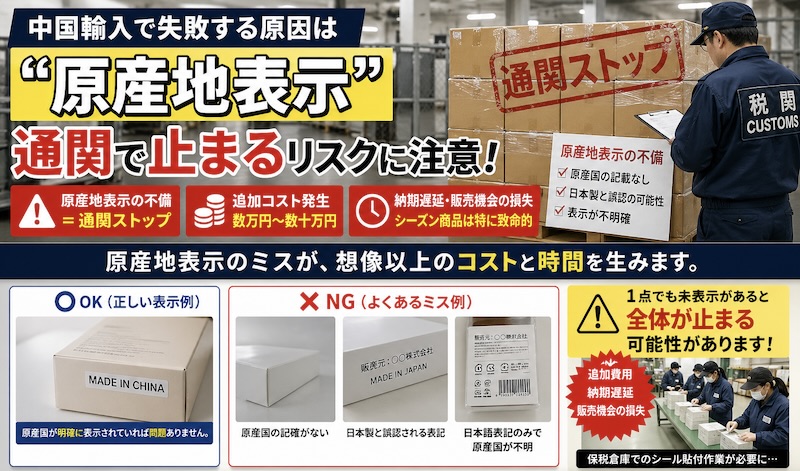
Misrepresentation of origin refers to a situation where the country of origin of a product is not correctly labeled or is labeled in a way that is misleading.
For example, when importing goods manufactured in China into Japan, it is necessary to include a label that clearly identifies the country of origin, such as “MADE IN CHINA” or “Made in China.”
However, the following situations frequently occur in practice:
・No
country of origin label on the product or packaging ・Labeled only in Japanese, with the country of origin unclear
・Seller information is provided, but the country of origin is not
listed ・Designs or wording that could be mistaken for "Made in Japan"
In such cases, customs authorities may determine that “the country of origin is unclear or could be misidentified,” which could lead to problems.
What happens if there is a misrepresentation of the country of origin?
This is the most important point.
If customs determines that there is an issue with the country-of-origin marking, the goods may not be cleared.
In such cases, the following actions may be required:
・Transfer
to a bonded warehouse ・Identification
of the affected goods ・Affixing
labels to all items ・Re-inspection
This series of steps can cause costs and time to skyrocket.
Major Costs Involved
・Labor costs
for applying labels ・Storage fees
・Workspace rental fees
・Re-inspection fees
These costs are generally borne by the shipper.
Another factor that is often overlooked is “opportunity cost.”
・Delays
in product launch ・Missed
sales opportunities for seasonal items ・Deterioration in inventory turnover
These invisible losses significantly erode profits.
The work takes longer than expected
For example, when applying labels to tens of thousands of items,
・It
can take over a week even with a team of two or three people. ・The process takes even longer
when content verification is included. ・Delays in customs clearance can cause you to miss the optimal sales window.
such situations can arise.
Furthermore, bonded warehouses often lack proper facilities, which frequently results in a heavy workload.
Real-life examples
In fact, there have been cases where goods were imported without any country-of-origin labeling or with insufficient labeling, resulting in the need to affix labels to tens of thousands of items in a bonded warehouse.
In such cases,
・additional costs
amounting to several hundred thousand yen and ・delivery delays of about two weeks
resulted in the loss of sales opportunities for seasonal products.
Inadequate country-of-origin labeling is not merely a mistake; it is a “cause of lost profits.”
Common Misconceptions
There’s a common misconception here.
"It's a small item, so it's fine," or "The quantity is small, so it's okay."
This is incorrect.
Country-of-origin labeling is assessed on a per-item basis.
In other words,
・If even one item lacks labeling, the entire shipment may
be deemed non-compliant. ・Small items are no
exception. ・Special care is required for OEM products.
These points require careful attention.
The preventive measures are simple, but putting them into practice is key.
So, how can we prevent this?
The answer is simple: the key is to “give specific instructions and verify them.”
・Give
the factory clear instructions, including the exact “location of the country-of-origin label.” ・Decide
in advance on the labeling method (sticker or printing). ・For OEM products, printing is generally preferred
. ・Decide
in advance whether the label will be placed on the product itself or on the packaging. ・Always verify
the presence of the country-of-origin label during the sample stage. ・Conduct
a final confirmation via photos before mass production. ・Perform a re-check during pre-shipment inspection.
By strictly following this process, you can prevent many issues before they arise.
Why is "proactive maintenance" so much cheaper?
When placing an order with a factory,
・Printing costs
・Label application costs
will be incurred.
However, these are strictly “preventive costs.”
On the other hand, if problems arise during customs clearance,
・Additional costs
ranging from tens of thousands to hundreds of thousands of yen ・Delays in delivery
・Lost sales opportunities
and other “damage costs” will be incurred.
This difference is significant.
hubbuyer's Sticker Support and "Stop Mechanism"
This is where hubbuyer’s support comes in.
To prevent misidentification of the country of origin, hubbuyer offers a "Made in China label application service."
This service includes:
• Applying stickers to the product
or packaging • Performing this service concurrently with
the inspection process • Final confirmation during pre-shipment checks
are carried out.
In other words, it is designed to “resolve issues before they become problems at customs.”
Another key feature of hubbuyer is our ability to make the decision to halt a shipment.
If there are deficiencies or risks regarding the country-of-origin labeling, we halt the shipment at the pre-shipment stage, make the necessary corrections, and then proceed.
This decision helps to:
・Prevents
unnecessary costs from occurring ・Reduces
the risk of delivery delays ・Avoids potential issues before they arise
.
When importing from China, success comes from "design," not "low prices"
Whether you can turn a profit on imports from China isn't determined by the purchase price alone.
What matters is:
・Risk management
・Inspection procedures
・Pre-sale planning
.
Even with the same product, the results can vary significantly depending on the design.
Country-of-origin labeling is the most fundamental of these factors and a crucial point that is often overlooked.
Summary
Country-of-origin labeling is not merely a formality; it is a critical factor that affects customs clearance, costs, and delivery times.
Inadequate labeling can lead to customs issues, additional costs, and delivery delays.
However, many of these issues can be prevented before shipment.
What matters is not just “moving forward,” but “whether you can make the decision to stop.”
When sourcing from China, success depends not on “buying cheaply,” but on “how you plan.”
Country-of-origin labeling is the first turning point.
Before moving forward with sourcing from China,
Please consult with hubbuyer first.