


Summary of this article:Global sourcing means buying goods, materials, or services from suppliers in different countries to get better prices, more capacity, higher quality, more innovation, and more stable supplies. Global sourcing can be very helpful for importers, brands, manufacturers, and retailers but it also comes with risks like inconsistent quality, compliance problems, longer lead times, currency exposure and geopolitical instability. This guide talks about what global sourcing is, why businesses use it, the most common global sourcing models, a useful strategy framework and the best ways to lower risk and boost performance.
What Does Global Sourcing Mean?
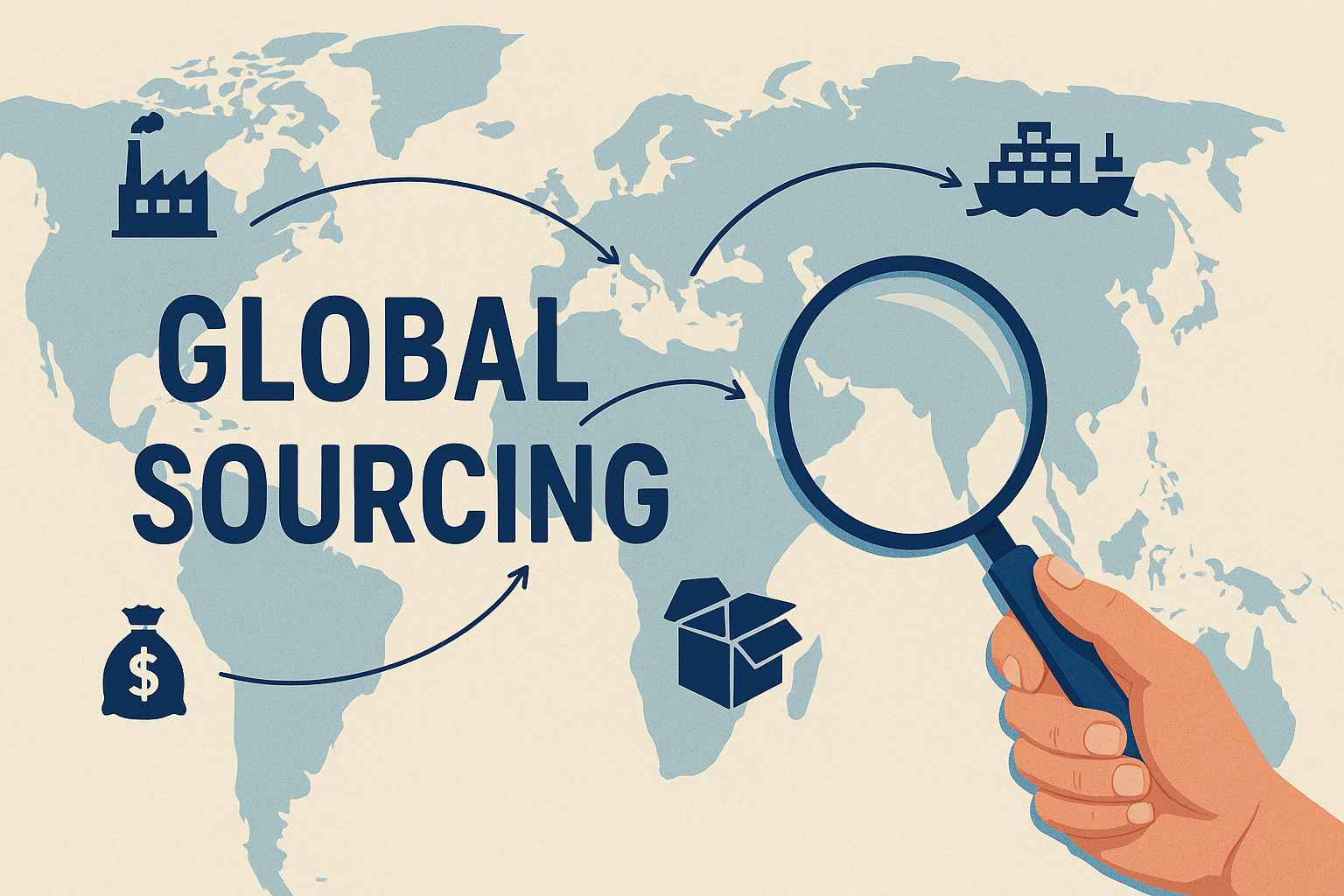
Global sourcing is a way for a business to buy things by finding and working with suppliers from other countries instead of just relying on suppliers in its own country. It usually has:
●Finding and qualifying suppliers across borders.
●Comparing costs and capabilities between countries and regions.
●Planning for international logistics and customs.
●Managing compliance and quality control.
●Reducing risk across multiple countries and finding new suppliers.
In short, global sourcing is more than just "buying from abroad." It's setting up a global network of suppliers and running it in a planned way.
Why Businesses Buy Things from Other Countries
1、 Lower total cost
To cut costs on manufacturing or buying, many businesses get their supplies from all over the world but advanced buyers are more interested in the total landed cost, which includes:
● Price per unit.
●Cost of packaging.
●Shipping and insurance.
●Taxes and duties.
●Cost of fixing or reworking a defect.
●The effects of delays and running out of stock.
2、Access to groups of specialized manufacturers
Different areas are better at making different types of products. Getting supplies from the right cluster can make things better, faster and give you more choices.
3、Capacity and Scalability
Global supplier networks can help you have more capacity during busy times and make you less reliant on one areas.
4、 New ideas and making new products
Some suppliers have better OEM/ODM capabilities, faster iteration or materials and processes that are unique to them.
5、 Spreading out risk
Because disruptions are happening more often, global sourcing helps multi-country supply strategies lower the risk of single-point failure.
Common Ways to Get Things from Around the World
Model 1: Low-Cost Country Sourcing (LCCS)
Get your goods from countries that are known for having lower prices.
Best for: Products with stable specs and low prices.
Risk: Quality may change if qualification is weak.
Model 2: Finding the best country for a certain category
Source based on specialization (quality and capability), not just cost.
Best for: Products that are high-quality and unique.
Model 3: China+1 (Diversification Across Many Countries)
Keep China as your main supply base but add another country as a backup or for certain product lines.
Best for: Managing risk, diversifying tariffs and managing geopolitical risks.
Model 4: Regional/Nearshore Sourcing Get your goods from places closer to your target market to speed things up and give you more options.
Best for: Quick restocking of demands that change with seasons and shorter lead times.
Model 5: Global Sourcing with a Mix of Sources
Put together more than one model:
●China for best-selling and older SKUs.
●A different country to spread out your investments.
●Local suppliers for quick restocking.
This is the most common way to do things in the real world.
Big Problems with Global Sourcing
Global sourcing adds new levels of complexity:
● The time it takes to get an order increases (production, ocean shipping, and clearance).
● The risk of poor quality goes up without good QC systems.
●Different markets have different rules for compliance, such as labeling, testing, and certificates.
● It is harder to spot when a supplier lies about their factory or trade when you are not there.
●Currency risk has an effect on the stability of prices
● Delays can happen because of problems with logistics, such as port congestion, changes in routes or geopolitical events.
●Communication problems cause misunderstandings about specs
A strong strategy uses process and data to fix these problems.
A 9-Steps Practical Framework For A Global Sourcing Strategy
Step 1: Write down your goals and limits.
Make sure you know what you want to improve:
●Lowest cost when it gets there?
●More consistent quality?
●Faster restocking?
●Safety and compliance?
●Spreading out risk?
Also, explain what constraints are:
●Target time for leads.
●Minimum order quantity that is acceptable.
●Limits on cash flow.
●Rules that must be followed in the destination markets.
Step 2: Group products by risk and value
Not all products need the same way of finding them.
A useful way to divide things up:
●Core or best-sellers need stable quality and two sources.
●Seasonal or trend SKUs need to be fast and flexible.
●High-risk items: fragile, regulated, and have a high return rate, so QC and compliance are stricter.
●Low-risk items are standard goods that are easier to find and cheaper to buy.
Step 3: Pick areas and make a map of your suppliers
Choose countries and groups based on:
●Specialization by category.
●Cost structure and ability.
●Policies on trade, tariffs, and duties.
●Logistics that connect you to your market.
●Risk exposure (political, currency, and disruption).
Step 4: Find suppliers (multi-channel pipeline)
You can build your supplier pipeline by doing the following:
●B2B platforms (to find things).
●Trade shows and fairs.
●Referrals from industry groups and clusters.
●Finding agents and local partners.
●Networks for third-party audits and inspections.
Goal: make a long list and then narrow it down to a short list.
Step 5: Check and Confirm Qualifications
Check the following before placing an order:
●Registering the business and its legal scope.
●If it's a factory or a trading company.
●Ability and capacity to make things.
●Process for managing quality.
●Experience with exporting and the ability to write documents.
●Compliance certificates and test reports (if necessary).
For categories with a higher risk, use:
●Checks of factories.
●Testing samples (lab tests if required).
●Checks of references.
Step 6: Change Control, Spec Lock, and Sampling
To keep things from getting messy and the quality from going down:
●Give the go-ahead for samples and keep a "golden sample" on hand.
●Make a spec sheet that keeps track of changes.
●Check the standards for packaging and the needs for cartons.
●Enforce change control (no changes without written permission)
This step is what makes things consistent across borders.
Step 7: Cost and Contracting (Think TCO)
When you decide to source goods from around the world, you should compare:
●Price levels and minimum order quantities.
●Cost of packaging and efficiency of shipping (size and weight of the box).
●Terms of payment.
●Romises about lead time.
●Policy for defects and claims.
●Responsibilities for warranties and after-sales services.
●IP and tooling ownership for OEM goods.
Don't just protect price with contracts; also protect quality and delivery.
Step 8: Make sure the quality is good and the logistics work.
Execution is what makes or breaks global sourcing.
Best ways to do things:
●Quality control during the process for medium- and high-risk orders.
●Checklist or AQL for pre-shipment inspection.
●Checks on packing and drop tests for things that break easily.
●Combining and optimizing cartons.
●Rules for shipping methods (air, sea, or express) based on how quickly and cheaply they need to get there.
●Correct papers: invoice, packing list, HS codes and labels.
Step 9: Managing and diversifying supplier performance
Keep an eye on supplier KPIs:
●Rate of on-time delivery.
●Rate of defects / rate of claims.
●Stable prices.
●How fast you can talk.
●Correctness of documents.
●Time to fix problems.
Then build resilience:
●keep backup suppliers (for best-selling items, use two sources).
●Spread out critical SKUs across different countries.
●Plan ahead for busy times.
● Do quarterly reviews of suppliers and projects to cut costs.
How to Build a Strong Global Supply Chain
●For your most important SKUs, use dual sourcing (primary and backup).
●Keep a database of suppliers (quote history, problems, certificates).
●Make RFQs the same so you can compare quotes.
●Put money into quality control; it's cheaper than returns and claims.
●Make sure to leave extra time for lead times, especially for ocean shipping.
●Make the packaging better to lower the cost of shipping and damage.
●Before making decisions, figure out the total landed cost.
● Keep an eye on risk (currency, disruption, policy changes) and be ready to change quickly.
Questions and Answers about Global Sourcing
Q1: Is global sourcing just for China?
No, China is still strong in many areas. Global sourcing means picking the best areas for cost, ability, and risk management.
Q2:What is "China+1"?
Companies use this strategy to lower risk or deal with tariffs and disruptions by keeping China as a main supply base and adding another country.
Q3: How do I make sure the quality is good when I buy from other countries?
Use a strong supplier documentation plan along with a spec lock, sampling, and inspection plan (both during the process and before shipping).
Q4: What is the biggest mistake in global sourcing?
Picking suppliers based only on the price per unit and not on the total landed cost, quality risk, and lead time reliability.
Final Thoughts
When global sourcing is set up as a system, it can greatly increase margins and supply flexibility. The best global sourcing programs include strategy (where/why), execution (QC/logistics/contracts) and continuous improvement (supplier scorecards and diversification).